A software company selling subscriptions through Stripe, with a smaller volume of one-time payments through Square, approached its Series A fundraise with a problem that only becomes visible when investors start asking questions: the revenue in its books didn't match the revenue in its billing systems, and nobody could say with confidence why.
Business Background
Stripe payouts were being posted to the books as a single lump sum per payout, with no breakdown by customer, subscription, fee, refund or dispute. Square transactions, a smaller but real share of revenue, weren't in the books at all — eighteen months of them. There was no deferred revenue schedule for multi-month subscriptions, meaning revenue recognition didn't follow ASC 606 in any defensible way. Churn, MRR and ARPU were being estimated from billing-system exports rather than calculated from reconciled financials, and the two didn't agree.
None of this was visible as a single crisis — it had accumulated quietly over a year and a half of a small team focused on product and growth, not books. It became a crisis the moment a term sheet made "show us clean financials" a hard requirement rather than a nice-to-have.
Key Challenges
- 18 months of Stripe payouts posted as lump sums, with no breakdown by customer, subscription, fee, refund, or dispute
- 18 months of Square transactions entirely absent from the books
- No deferred revenue schedule — multi-month subscriptions recognized on a cash basis, not ASC 606
- Revenue in the books did not match revenue in the billing systems, and the gap had never been quantified
- Churn, MRR, ARPU and cohort retention calculated ad hoc from billing exports, unreliable and not tied to reconciled financials
Impact
Series A due diligence puts financials under a level of scrutiny a growing SaaS company's internal bookkeeping rarely anticipates. Unreconciled payment processor activity, no formal deferred revenue schedule, and inconsistent SaaS metrics are exactly the findings that slow a raise down or invite a valuation discount, because they read as a controls problem even when the underlying business is healthy. The company needed this fixed on fundraising's timeline, not accounting's usual timeline.
Requirements & Expectations
- A chart of accounts built for SaaS: subscription revenue, one-time fees, refunds and processing fees separated cleanly
- Every dollar of the 18-month Stripe and Square history traced, reconciled and correctly posted
- A deferred revenue schedule for every multi-month subscription, compliant with ASC 606
- Investor-grade financial statements — P&L, balance sheet, cash flow — formatted to what a VC diligence process expects
- A live, trustworthy SaaS metrics dashboard: MRR, ARR, churn, ARPU, cohort retention, updating from the reconciled books, not a side spreadsheet
- All of the above inside a three-week window, ahead of the term sheet's diligence deadline
Strategic Approach
With a fixed deadline and 18 months of history to reconcile, we worked backward from what diligence would actually check rather than tidying chronologically. Chart of accounts came first, because every subsequent posting decision depended on it existing correctly. Stripe reconciliation came before Square, since it carried the larger volume and the ASC 606 schedule depended on subscription data that only Stripe held. Square, refunds, and the SaaS dashboard followed once the core subscription ledger was trustworthy.
Comprehensive Solution
- Rebuilt the Zoho Books chart of accounts for a SaaS business, separating subscription revenue, one-time fees, refunds, and payment processing fees so each reported correctly for the first time.
- Reconciled 18 months of Stripe payouts, breaking each payout down into subscriptions, fees, refunds and disputes, and posting each component to the correct account rather than as a lump sum.
- Imported and reconciled 18 months of Square transactions, mapping each one to its correct customer and invoice inside Books, closing the gap where this revenue had simply been absent.
- Implemented ASC 606 revenue recognition, building a deferred revenue schedule for every multi-month subscription so recognized revenue matched the service period, not the cash received.
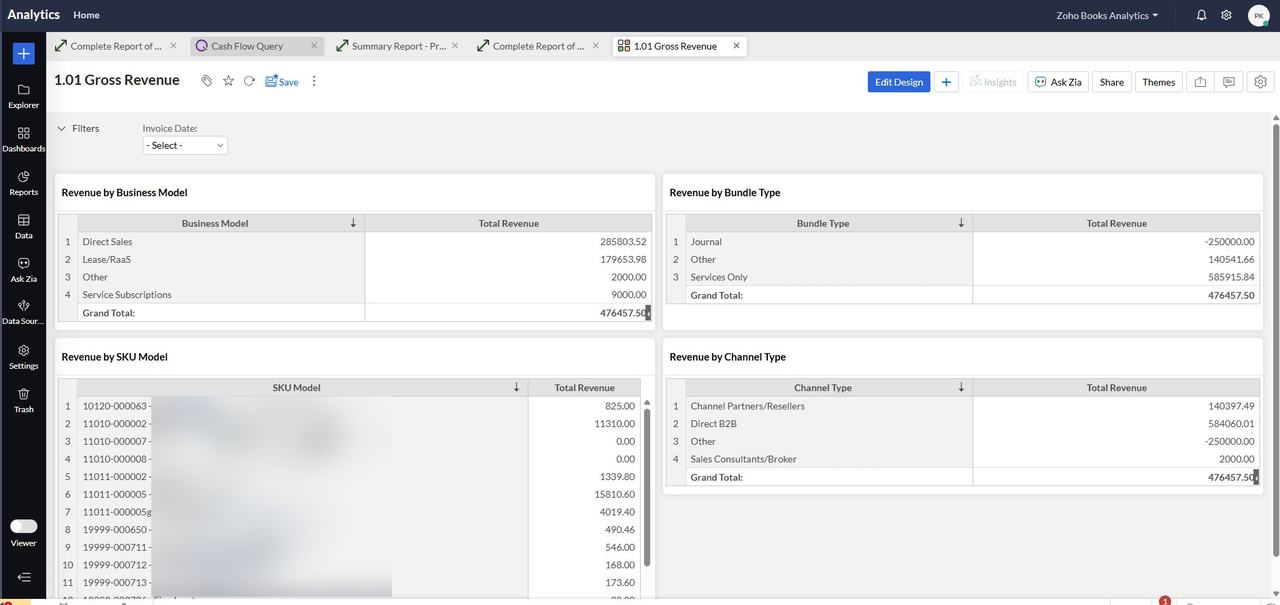
- Built a Zoho Analytics dashboard showing MRR, ARR, churn rate, ARPU and cohort retention, pulling directly from the now-reconciled Books data rather than a manually maintained spreadsheet.
- Delivered investor-grade financial statements — P&L, balance sheet and cash flow — formatted to the standard a VC diligence team expects to see.
Measurable Results
Key Takeaway: a payment processor's payout summary is not a revenue record — it's a cash movement. Treating Stripe and Square payouts as the source of truth for revenue, instead of reconciling each one down to the transaction level, is exactly how eighteen months of real revenue goes unrecorded without anyone noticing until diligence forces the question.
Client Impact
For the founders
Walked into diligence with financials that matched their billing systems and a defensible ASC 606 position, instead of having to explain a reconciliation gap mid-raise.
For the finance function
Went from maintaining SaaS metrics in a side spreadsheet to a live dashboard that updates itself from reconciled data — no more reconciling the metric to the ledger after the fact.
For investors
Received financials and a metrics dashboard in the format their own diligence process was built to evaluate, removing a common source of delay in SaaS Series A rounds.
Conclusion
A growing SaaS business that has never been forced to reconcile its payment processors down to the transaction level is not necessarily in trouble — but it is carrying risk it hasn't measured. Doing that reconciliation before a raise, rather than during one, is the difference between a clean data room and a delayed one.
Raising, and not sure your Stripe or Square revenue actually matches your books?
We can tell you where the gap is, and how big it is, before an investor's diligence team does.
Talk to an Expert → Book a Call Today →