A robotics and industrial-equipment company that sells hardware outright, leases the same equipment under multi-year contracts, sells service and maintenance contracts on top, and supplies consumables to the same customer base, came to us with a closing problem that had quietly become a planning problem. Nobody could say, with confidence, what the business had actually earned in a given month until the tenth working day of the next one.
Business Background
The client had grown its four revenue lines organically, adding leasing and service contracts as the equipment business matured, without ever revisiting how each one was recorded. Equipment sales were entered into a spreadsheet by the sales coordinator. Lease schedules, which needed month-by-month invoicing over contract terms running two to five years, were tracked in a separate lease-management sheet with no link to accounting. Service contract renewals lived in the inboxes of the two engineers who managed client relationships. Consumables were invoiced ad hoc, whenever someone remembered a customer was due a refill order.
None of these four systems shared a customer ID, an invoice numbering series, or a chart of accounts. Closing the books meant someone manually pulling data from all four, matching it by hand against bank statements, and hoping nothing had been missed. It usually had been.
Key Challenges
- Four revenue models (equipment sales, operating leases, service contracts, consumables) tracked in four disconnected places with no shared customer or invoice reference
- Recurring lease invoices generated manually, averaging four to six missed or late invoices a month across the active lease book
- Service contract renewals tracked in email, with no systematic alert before a contract lapsed
- Month-end close taking 10 working days, largely spent reconciling four sources rather than reviewing numbers
- No per-revenue-stream profitability visibility — leadership could see total revenue, not which of the four models actually drove margin
Impact
A 10-day close is not just a reporting delay. It meant management decisions — pricing a new lease, deciding whether to chase a service renewal, judging whether consumables pricing needed revisiting — were routinely made on numbers that were between one and five weeks stale by the time anyone acted on them. Missed recurring invoices, averaging four to six a month, were not catastrophic individually, but compounded into a meaningful, quietly-eroding revenue leak that nobody was tracking as a single number until we did.
Requirements & Expectations
- One system of record for all four revenue models, each correctly mapped to its own income account and GST treatment
- Recurring lease invoicing that required zero manual step once a lease was signed
- A single view connecting CRM deal activity to Books billing, so a won lease deal didn't need to be re-entered as a billing setup
- Automated alerts ahead of service contract renewal dates, routed to the right sales engineer
- A month-end close inside a week, without adding headcount to the accounts team
Strategic Approach
Rather than digitizing each of the four tracking methods separately, which would have preserved the disconnection between them, we treated this as a single-system problem from the start: map every revenue model into Zoho Books with its own accounts, build Zoho CRM as the front end that captures the deal and the contract terms, and wire the two together so a transaction never has to be entered twice. The sequencing mattered — CRM structure had to be right before automation could trigger correctly from it, so CRM configuration came first, Books mapping second, and automation last.
Comprehensive Solution
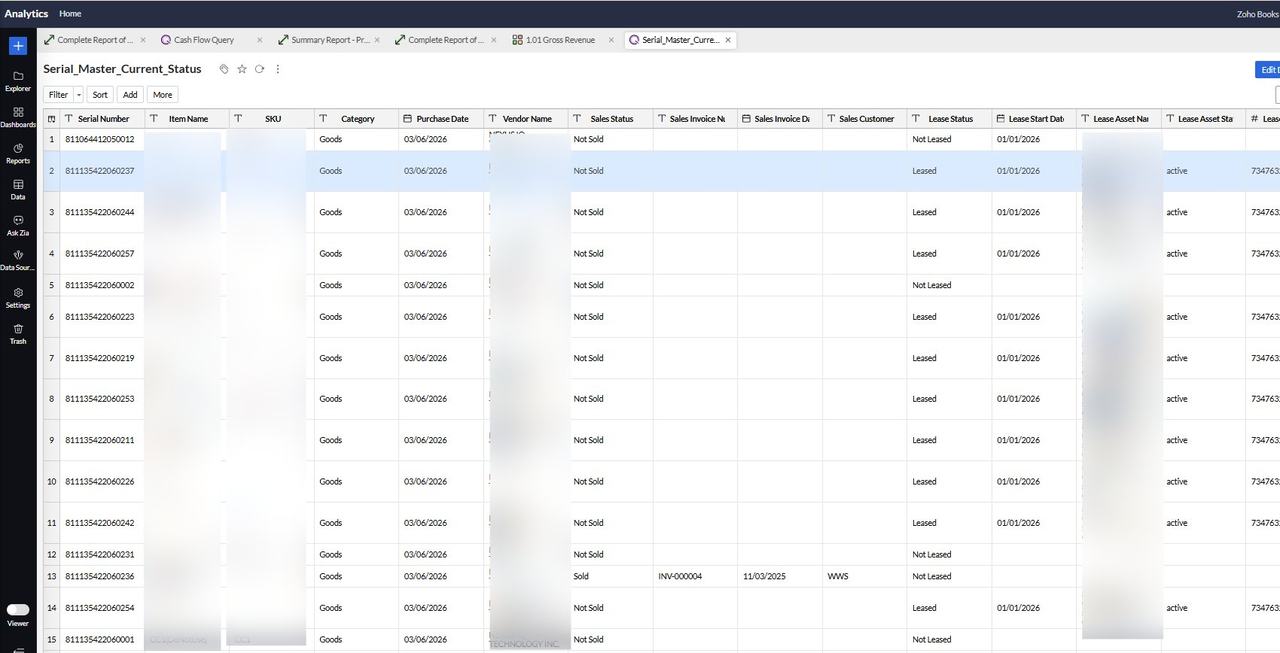
- Mapped all four revenue models in Zoho Books, each with its own income account and correct GST treatment, so equipment sales, lease income, service revenue and consumables never mixed in reporting.
- Built recurring invoice automation for every operating lease, generating and sending the invoice on the correct contract date every month with no manual trigger.
- Configured Zoho CRM with equipment and lease deal tracking, including custom fields for equipment serial numbers and contract end dates, so every asset and every contract term lived against the deal record.
- Connected the deal-to-invoice pipeline: when a lease deal was marked won in CRM, its recurring invoice schedule was created in Books automatically, with no re-entry step.
- Built service contract renewal alerts, firing 60 days before contract end — a task to the sales engineer and a renewal proposal draft to the customer, both automatic.
- Implemented managed monthly bookkeeping on top of the new connected system — GST, TDS, payroll and CFO-level reporting running off the same data, not a fifth spreadsheet.
Measurable Results
Key Takeaway: the close was never actually a 10-day accounting problem. It was a four-system reconciliation problem wearing an accounting deadline. Once the four revenue models lived in one system with automated hand-offs between CRM and Books, the close became what it should have been all along: a review step, not a data-hunting exercise.
Client Impact
For the accounts team
The monthly close stopped being a fire drill. Reconciliation across four sources was replaced by reviewing one system, freeing the team to spend close week on actual review rather than data assembly.
For the sales engineers
Renewal alerts now come to them automatically, 60 days out, instead of depending on memory across a growing book of service contracts — renewal conversations start earlier and are better prepared.
For leadership
Per-model P&L reporting made it possible, for the first time, to see which of the four revenue lines was actually driving margin rather than just topline revenue — informing where the business chose to grow next.
Conclusion
Multi-revenue-model businesses rarely have a single broken process; they have several adequate ones that were never connected. The fix is not a better spreadsheet for each one — it's one system that each revenue model reports into correctly, with the hand-offs between them automated rather than remembered.
Running more than one revenue model through separate trackers?
If your close depends on reconciling multiple disconnected sources by hand every month, that's a system design problem, not a staffing one. We can tell you in one conversation what it would take to fix.
Talk to an Expert → Book a Call Today →