A 40-person architecture and interior design firm had, over a decade of organic growth, ended up running seven different functions on seven different tools that had never been designed to work together. Enquiries lived in an inbox. Timesheets lived in per-architect spreadsheets. Site-visit expenses arrived as WhatsApp photos of receipts. A physical materials sample library — tile, veneer, fixture and finish samples — had no check-out record at all. Payroll was run by an external agency with no link back to project cost. Client revision requests were scattered across email threads with no way to see what was still open. The result: not even the partners could say, with confidence, which projects were actually profitable.
Business Background
Each of the seven tools had made sense in isolation when it was adopted — an inbox for enquiries costs nothing to set up, a spreadsheet is the fastest way to start tracking timesheets, WhatsApp is simply how a site engineer already communicates. The problem was never any single tool; it was that a decade of these individually-reasonable choices had never been connected, and the firm had reached a scale — 40 people, dozens of concurrent projects — where the absence of connection was actively costing money nobody could point to.
Key Challenges
- Project enquiries tracked in an email inbox, with no pipeline stage or conversion visibility
- Timesheets kept in per-architect spreadsheets, uncollated and unlinked to project cost
- Site-visit expenses submitted as WhatsApp photos of receipts, with no approval trail or project tagging
- A physical materials sample library with no check-out or check-in record, effectively unaccounted for
- Payroll run by an external agency, entirely disconnected from project overhead allocation
- Client revision requests and site RFIs scattered across email threads, with no way to see what remained open
- No project, across the firm's full portfolio, ever showed a reliable true margin
Impact
A firm that cannot see project profitability cannot make an informed decision about which project types to pursue, which to price higher, or which to decline. This firm was, in effect, choosing its next ten projects on instinct and relationship, not data — in a business where project types (a large commercial fit-out versus a residential renovation, say) can carry meaningfully different margins for reasons that only show up when cost is tracked accurately against revenue.
Requirements & Expectations
- An enquiry-to-project pipeline with proper stages, replacing the inbox
- Milestone-based invoicing tied to actual design-phase completion, not a manually-remembered follow-up
- A digital record of the materials sample library, checked in and out by project
- Mobile expense submission with an approval chain, tagged to project automatically
- Payroll cost flowing into project overhead without manual allocation
- Client revisions and RFIs tracked as tickets against the specific project
- A live profitability dashboard combining revenue, staff cost, and site expense by project
Strategic Approach
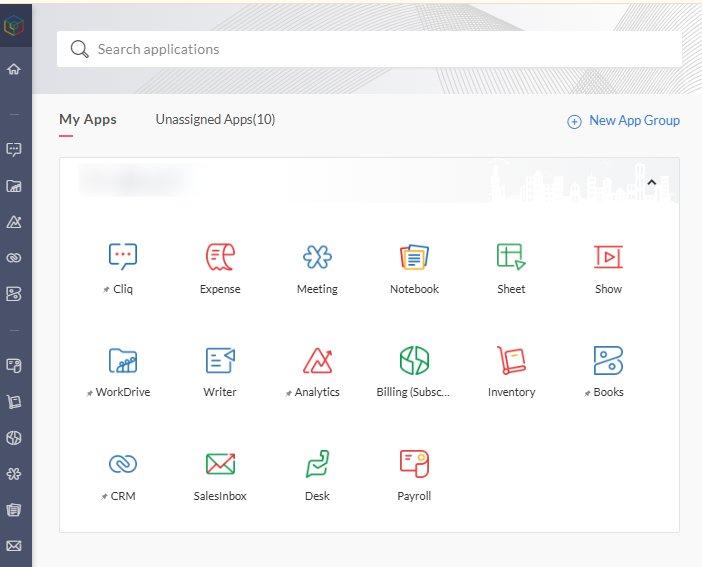
Seven disconnected tools meant seven separate migrations, but the sequencing had to follow the business's own workflow rather than a generic app-by-app rollout: CRM first, because every other module ultimately hangs off the deal record; Books second, since milestone billing needed the CRM structure in place to trigger from; then Inventory, Expense, Payroll, Desk and Analytics layered on, each connected back to the same project record rather than standing alone.
Comprehensive Solution
- Zoho CRM — built the enquiry-to-project pipeline with custom stages (Enquiry, Site Visit, Design Brief, Proposal Sent, Project Won) and custom fields for site location, built-up area, and project type.
- Zoho Books — configured project-wise milestone invoicing matched to each design phase (concept, schematic, design development, construction drawings, site supervision), with vendor and contractor bills tracked per project.
- Zoho Inventory — digitised the materials sample library with check-out and check-in tracking per project, replacing a shelf nobody could account for.
- Zoho Expense — enabled mobile submission of site-visit and travel claims with a receipt photo, auto-tagged to the project and routed through an approval chain before reimbursement.
- Zoho Payroll — configured the salary structure for architects, drafters and site engineers in-house, with payroll cost automatically allocated to project overhead in Books.
- Zoho Desk — logged client revision requests and site RFIs as tickets against the specific project, replacing threads that used to get lost.
- Zoho Analytics — built a project profitability dashboard combining billed revenue from Books, staff cost from Payroll, and site expenses from Expense, refreshed automatically.
- Cross-module workflow — a deal won in CRM auto-creates the project shell in Books with its milestone billing schedule pre-loaded, with no manual setup step.
Measurable Results
Key Takeaway: the firm didn't have seven small problems. It had one problem — no shared system — expressed seven different ways. Fixing it required treating all seven as one implementation with one project record at the centre, not seven separate digitisation projects run in parallel.
Client Impact
For the partners
Saw project-level profitability for the first time, and could finally make an informed call on which project types were actually worth taking on.
For architects and drafters
Timesheets and expense claims moved from spreadsheets and WhatsApp photos into one mobile-friendly system, with far less admin overhead per week.
For clients
Revision requests now get logged and tracked as tickets rather than disappearing into an email thread, with visible status instead of a follow-up phone call to check.
Conclusion
A firm running seven adequate, disconnected tools usually isn't a firm with seven small problems to fix — it's a firm with one implementation to do, once. Doing all seven together, around one shared project record, is what actually produces the profitability visibility that fixing them one at a time never would.
Running your practice across a patchwork of tools that grew one decision at a time?
We can map what you're running today against what one connected Zoho One system would look like, and what it would take to get there.
Talk to an Expert → Book a Call Today →